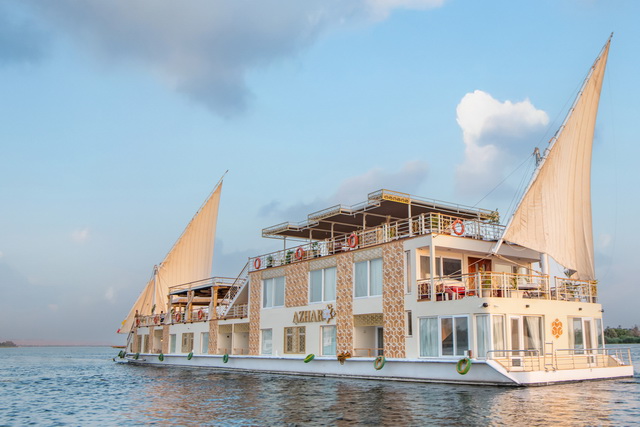
Dahabiya vs Nile Cruise Ship: Which Should You Choose?
6 min read
Both will carry you between Luxor and Aswan past the great temples — but the experience could hardly be more different. Here is how a traditional dahabiya compares with the large floating hotels.
Scale and privacy
A standard Nile cruise ship carries 100 to 300 guests across several decks. A dahabiya is a small sailing boat — the Azhar takes just sixteen guests in eight suites, or your party alone on a private charter.
That difference shapes everything: no queues, no crowds, no fixed sittings — just a handful of travellers and an attentive crew.
Where you can moor
The large ships are limited to the main docks and busy sites. A shallow-draft dahabiya can moor on quiet islands and sandbanks, and reach smaller sites such as El Kab and Gebel el-Silsila that the big boats sail straight past.
You often arrive at Edfu or Kom Ombo when the crowds have gone — or before they arrive.
Sailing, dining and pace
When the wind is fair a dahabiya moves under its lateen sails, silent but for the water against the hull. Meals are cooked fresh for your table rather than served at a buffet, and the day flexes around you — linger at a temple, moor early to swim, dine ashore under the stars.
A cruise ship runs to a fixed schedule and a set menu. If you want efficiency and entertainment, that suits; if you want intimacy and calm, a dahabiya wins.
Ready to sail the Nile?
Tell us your dates and party and we'll craft a proposal aboard the Azhar — or take the whole boat privately.
Frequently asked
What is a dahabiya?
A dahabiya is a traditional two-masted Nile sailing boat with a small number of cabins — a private, unhurried alternative to the large cruise ships.
Is a dahabiya more expensive than a cruise ship?
Per person it can be comparable to a premium cruise, but you are paying for far fewer guests, more space, flexible itineraries and sites the big ships cannot reach.